Showing posts with label Cats as Marketing Tools. Show all posts

Morris, the ultimate cat snob

2 little kitties
Morris, the ultimate cat snob

Think of “spoiled cat” and you probably think of Morris, the spokes-cat for the 9-Lives brand of cat food. Morris was found at an animal shelter in a Chicago suburb, and the Leo Burnett ad agency turned the big orange tabby into a superstar.

He debuted in ads in 1969 but died in 1975 and was quickly replaced by a Morris lookalike. The “real” Morris the cat was John Irwin, the man who provided the bored, haughty voice of the oh-so-finicky cat.

The Hello Kitty phenomenon

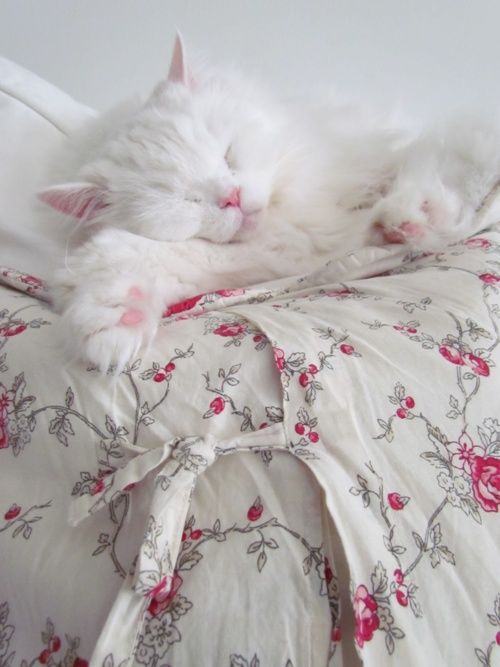
Cute white sleepy cat
The Hello Kitty phenomenon

One of the merchandising marvels of the last twenty years has been Hello Kitty, the brainchild of the Sanrio Company of Japan. Buyers consider the countless Hello Kitty products—toys, watches, clothing, figurines and other collectibles—to be adorable with a capital A.

The main character is Kitty White, who is (big surprise) a white kitten, always sweet and considerate, always with a red bow on one ear. She lives with her family in London and loves to give tea parties and bake cookies.

The cast includes her adorable parents and grandparents, her adorable twin sister (who wears a yellow bow) and her adorable animal friends—monkeys, moles, raccoons, even dogs and mice. One thing all the characters have in common, besides being adorable: they have no mouths. It is a “cult of the cute,” but what cat lover would complain?

The grand-daddy of all cat logos

♥ Cat in the window.
grand-daddy of all cat logos

Most of the cat advertising images mentioned in this section are long gone, but one lingers on, and that is the Cat’s Paw cat, the black mascot of Cat-Tex shoe soles and rubber heels. Cat’s Paw began in the early 1900s when the Massachusetts Chemical Company began using the name for its rubber shoes and then later for soles and heels.

Knowing that people were aware of how surefooted cats are, the company employed slogans like “I never slip” and “The heel with nine lives.”

The most familiar image, still seen on Cat’s Paw products, shows the head, shoulders and (of course) extended paw of a black, red-eyed cat. Many a U.S. shoe repair shop had (and has) a Cat’s Paw clock prominently displayed.

Ah, slumbering Chessie

Cat love wool
Ah, slumbering Chessie

The Chesapeake and Ohio Railroad still exists, but you can no longer sleep on a C & O car, since the line no longer has passenger cars. But in days past the railroad advertised you could “sleep like a kitten” on C & O trains, and the railroad’s logo was an adorable tabby kitten, Chessie, snuggled under a sheet with its head and one paw showing.

Chessie was taken from a picture made by the artist Guido Gruenwald that was purchased by a C & O executive. C & O ran its first ad with Chessie in 1934, and the company was flooded with requests for copies of the image.

The railroad knew a good thing when they saw it and started marketing the Chessie image on clothing, bags, playing cards and other consumables. The tiny kitten was, at that time, the best-known cat in America.

Thread cats

So sweet !
Thread cats

You might be familiar with the Coats and Clark Company, a maker of thread. Back before Coats and Clark merged, Clark’s Thread hit upon a rather obvious advertising ploy: show an adorable kitten playing with the thread. (After all, everyone knows that cats and kittens like to chase strings and threads.)

The idea caught on, and other thread companies used cats in their ads. The Corticelli Company, for example, showed two adorable white kittens frolicking with spools of thread of all colors, with the slogan “Too strong to break.” In their day—the first decade of the twentieth century—the Corticelli kittens were among the most famous ad cats in the world.

Before Socks, stockings

Black Cat
Before Socks, stockings

Black cats with white paws were being named Socks well before the Clinton presidency, and perhaps that suggested the brand name Black Cat to the Cooper brothers of Kenosha, Wisconsin, who founded the Black Cat Hosiery Company in the 1890s.

All the socks and hose produced by the company bore the image (on the toe) of a grinning black cat with a ribbon around his neck. (It was actually “grinnier” than the Cheshire cat of Alice in Wonderland.) In time the a in black and cat morphed into the front legs of the black cat image.

. . . And nearby, his white brother

Eyes
... And nearby, his white brother

One of the Cooper brothers who founded the Black Cat Hosiery Company started a firm (just across the street) to manufacture underwear.

In a remarkable leap of creativity, the company chose to use a grinning cat with a ribbon around his neck as its logo, and the company was called White Cat. Many years later, this company morphed into Jockey, now a well-known maker of underwear.

The Coke cat

gorgeous!!!!!!
The Coke cat

The Coca-Cola Company has been around for a long time, and has, naturally, produced some memorable ads to promote its products.

One ad from the 1920s showed a stylishly dressed woman of the period drinking Coke, while her equally stylish white cat drank milk from a blue bowl.

The Kellogg’s cats

beautiful kitten
The Kellogg’s cats

Producing various cereals over so many decades, the Kellogg’s Company has inevitably featured cats in some of its ads (even though cats have zero interest in eating cereal themselves).

An ad for Kellogg’s Toasted Corn Flakes from the early twentieth century depicted a child holding a gray cat, with the tag line “For Kiddies, Not Kitties.” A couple of decades later, the kiddies could order, from the back of a Kellogg’s cereal box, a huggable doll, Crinkle the Cat.

Tiddledywinks, feline style

Reading is fundamental
Tiddledywinks, feline style

The old children’s game of tiddledywinks seems pretty quaint compared to today’s video games, but it is still available, and basically unchanged. It was ridiculously simple: coinlike disks were used to flip smaller disks into a cup to score points.

In the 1930s the English firm of J. W. Spear and Son produced its Little Kittens version of the game, in which the cups were mouths and paws of some gaping kitten figurines.

Dueling tomcats

Dueling tomcats

Parker Brothers, the famous board-game company that gave the world Monopoly, Sorry, Risk and other classics, is an old firm, dating back to the 1800s. One of its early products was the Amusing Game of Kilkenny Cats, obviously a take off on the old expression “fighting like Kilkenny cats”.

The game box depicted two cats (presumably toms) in waistcoats, aiming their dueling pistols at each other while their cat friends stood nearby awaiting the outcome.

Psychic cats

White kitten
Psychic cats

Parker Brothers later produced another cat parlor game, the Black Cat Fortune Telling Game, which debuted in 1897. The game involved cards of the four standard suits, each with a cat image on the back.

Matching the words on the cards’ backs could (supposedly) tell the players’ fortunes. No doubt Parker Brothers was counting on buyers to connect cats (black ones especially) with the occult and witchcraft.

Rodent-killing competition

Hiding under the table
Rodent-killing competition

Inevitably some of the products sold to kill rats and mice would have to use cats as part of their marketing strategy. In the 1870s, the businessman Ephraim Wells developed a product he called Rough on Rats (field-tested in his own rat-infested home).

Some of the ads for Rough on Rats showed a bevy of disappointed and alarmed cats, lamenting that they had been replaced by the amazing product.

Tsuda’s costumed cats

kitty
Tsuda’s costumed cats

“Cats can’t be taught tricks.” Well, some can, as proven by Satoru Tsuda of Japan. He came up with the idea of using trained cats in TV ads in unconventional ways. He took in four strays and taught them not only to pose for the camera but to wear costumes of various types, including street thugs, punk rockers, policemen and soldiers.

The costumed cats were seen on TV, billboards, print ads and naturally made their way via merchandising into calendars, posters and jewelry. Not bad for a band of homeless cats and a very patient (and later very wealthy) trainer.

Cats and cigar logos

Maine coon
Cats and cigar logos

Cigars were (and, mostly, still are) a “guy thing,” so perhaps it is surprising that cigar companies in the 1800s so often used cats in their names and logos. In those days it was generally assumed that “real men” (the kind who smoked cigars, that is) were more fond of dogs than cats.

Nonetheless, cigar boxes and wrappers from the nineteenth century testify to the many cat names and images used by cigar companies: Two Toms, Old Tom, Mr. Thomas, Cats, Tabby, Me-Ow, Our Kitties, White Cat and, yes, even Pussy. Some showed cats smoking cigars (fat chance!), and the Me-Ow logo showed two black tomcats in the claws-out, backs-up fighting stance.

Cats and stoves

aww
Cats and stoves

The days of the black stove that burned wood or coal are long gone, but in the old days keeping the stove’s iron finish free of rust was essential, so various companies marketed “stove polish.” One brand was Black Cat, manufactured by the J. S. Prescott Company.

Naturally the label pictured a black cat (with a red ribbon on his neck). While there is no connection between cats and stoves, the sleek coat of a black cat surely would have reminded buyers of how their stoves ought to look.

Cat compacts

It's a cuddle puddle of cuteness and love. When the sleepy bug bites, little foster kitties snuggle up together.
Cat compacts

Back in 1930s America (there was that Depression, remember?) store customers were always happy to get something for free.

One “freebie” was the paper compact, a cardboard-encased compact mirror given free to women, always (of course) bearing inside it an ad for some store or service.

Some of these compacts bore the face of a cat on the inside, perhaps because most women find cats appealing and perhaps because cats (like mirrors) are associated with grooming.

Cat-and-dog product

White Bengal Tiger
Cat-and-dog product

If you had to guess, what would you think a product called Honest Scrap would be? The answer: chewing tobacco.

Honest Scrap was a brand of chewin’ backy produced by the Lorillard company, and one of its advertising images was a black cat facing off with an only slightly larger white dog. The image bore the title “An everyday scrap.”

The catnip toy guy

Ups ...
The catnip toy guy

Catnip-filled balls and catnip-filled mice toys have been around a long time—in fact, since 1907, when a veterinary supplier, A. C. Daniels, patented his Catnip Ball, a small wooden ball, hollowed out for holding catnip and serving as a great toy for felines.

Later he patented the first catnip-filled toy mouse. Naturally Mr. Daniels also marketed his own catnip, under the brand name Summit.

Babies and tires

White cat & kittens plus a ginger kitten
Babies and tires

The Michelin tire company has been using its adorable baby image for several years now, accompanied by the slogan “There’s a lot riding on your tires.”

Back in the 1920s, the Fisk Tire Company of Massachusetts was already using a protective parent image, but not a human one: one of the company’s ads showed a fierce-looking mother cat frightening a dog away from her basket of wide-eyed kittens.

Interestingly, on the wall behind the kitten basket is a pre-Michelin image of a tot holding a tire, with the slogan “Time to Re-tire—get a Fisk.” We can assume that tire buyers were expected to connect new tires with the parental protectiveness of the mother cat.
Related Posts with Thumbnails